
Requirements
| Component | Requirement |
|---|---|
| PHP | 8.0+ |
| guzzlehttp/guzzle | ^7.0, installed automatically with the package |
| psr/log | ^3.0, installed automatically with the package |
| ext-pdo_mysql | Optional; required for Doris/StarRocks SQL; Stream Load is plain HTTP |
| apache/thrift | Optional; required for Hive / Spark Thrift Server, supports ^0.24 or ^0.25 |
| mroosz/php-cassandra | Optional; required for Cassandra, ^1.2 |
| aws/aws-sdk-php | Optional; required for Hudi/Paimon S3 storage |
Framework adapter versions and minimum PHP versions:
| Framework | Supported versions | Minimum PHP |
|---|---|---|
| Laravel | 9 / 10 / 11 | 8.0 for 9, 8.1 for 10, 8.2 for 11 |
| ThinkPHP | 6 / 8 | The package itself requires 8.0; ThinkPHP 8 also requires 8.0 |
| Webman | 1.4+ / 2.x | 8.0 for 1.4+, 8.1 for 2.x |
| Hyperf | 3.x | 8.1, and requires Swoole 5 |
| Yii2 | 2.0.46+ | 8.0 |
| Yii3 | 3.x | 8.1 |
A framework's own minimum PHP version may be higher than this package's 8.0; the framework requirement takes precedence.
Installation
Standard installation (available on Packagist):
composer require erikwang2013/bigdata-php:^2.0
The package is declared as yii2-extension so Yii2 can auto-register its component; Laravel, ThinkPHP, Webman, Hyperf, Yii3, and non-Yii2 projects still install it as a normal Composer library. See section 6 for framework registration.
Install optional dependencies as needed:
composer require apache/thrift           # Hive / Spark Thrift Server
composer require mroosz/php-cassandra    # Cassandra
Doris / StarRocks need no extra Composer package, but the pdo_mysql extension must be enabled in php.ini.
Quick Start
use Erikwang2013\BigData\BigData;

$trino = BigData::driver('trino', [
    'host' => '127.0.0.1',
    'port' => 8080,
    'user' => 'php',
    'catalog' => 'hive',
    'schema' => 'default',
]);

$result = $trino->query('SELECT 1 AS id');

foreach ($result->rows() as $row) {
    echo $row[0], PHP_EOL;
}
Common ResultSet methods:
$result->columns(); // Column names or column descriptions; exact structure is driver-defined
$result->rows();    // Row arrays; null values are preserved as-is
$result->count();   // Number of rows
$result->raw();     // Raw driver response, useful for debugging protocol details
Scheduler-driver example:
$airflow = BigData::driver('airflow', [
    'baseUrl' => 'http://127.0.0.1:8081',
    'username' => 'admin',
    'password' => 'admin',
]);

$airflow->triggerDag('daily_etl', ['date' => '2026-10-29']);
Optional-driver mode:
BigData::drivers();   // All 21 driver keys
BigData::available(); // Driver keys whose optional dependencies are present in the current environment

try {
    $hive = BigData::driver('hive', ['host' => '127.0.0.1']);
} catch (\Erikwang2013\BigData\Exception\DriverUnavailableException $e) {
    echo $e->getMessage(); // Contains a composer require apache/thrift hint
}
Drivers can also be instantiated directly. Direct instantiation bypasses the optional dependency check; a missing extension or class fails at runtime:
use Erikwang2013\BigData\Driver\Trino\TrinoClient;
use Erikwang2013\BigData\Driver\Trino\TrinoConfig;

$trino = new TrinoClient(TrinoConfig::fromArray([
    'host' => '127.0.0.1',
]));
Framework Integration
The core package depends on no framework. The adapters in src/Integration do only two things: read the unified default / drivers configuration and bind Erikwang2013\BigData\Integration\Manager to the framework container.
Each adapter has a dedicated guide: Laravel, ThinkPHP, Webman, Hyperf, Yii2, Yii3.
On first boot the adapter copies the config template to the framework's conventional path: config/bigdata.php for Laravel, ThinkPHP, Webman, and Yii2, and config/autoload/bigdata.php for Hyperf. Yii3 needs no copy because yiisoft/config merges the package config automatically. Existing files are never overwritten.
After composer require, registration follows each framework's own rule:
| Framework | Registration |
|---|---|
| Laravel | extra.laravel.providers, discovered automatically |
| ThinkPHP | extra.think.services; the skeleton runs service:discover on post-autoload-dump |
| Hyperf | extra.hyperf.config, merged automatically |
| Yii3 | extra.config-plugin, merged by yiisoft/config |
| Webman | the post-package-install plugin hook writes config/plugin/erikwang2013/bigdata-php/ (app.php + bootstrap.php) |
| Yii2 | type=yii2-extension + extra.bootstrap; yiisoft/yii2-composer registers the component |
Unified configuration structure (identical across frameworks):
// config/bigdata.php
return [
    'default' => 'trino',
    'drivers' => [
        'trino' => [
            'host' => '127.0.0.1',
            'port' => 8080,
            'user' => 'php',
            'catalog' => 'hive',
            'schema' => 'default',
        ],
        'airflow' => [
            'baseUrl' => 'http://127.0.0.1:8081',
            'username' => 'admin',
            'password' => 'admin',
        ],
    ],
];
Public behavior of Manager:
driver()usesdefault;driver('airflow')uses an explicit name; instances with the same name are cached.drivers()returns the driver names configured underdrivers.available()returns the configured driver names whose optional dependencies are all present.- Only drivers configured in
driverscan be created; an unknown name throwsInvalidArgumentException.
Laravel
The package declares the provider under extra.laravel.providers, so Laravel discovers and registers it automatically after composer require; no config/app.php or bootstrap/providers.php edit is needed. The provider writes config/bigdata.php on first boot and never overwrites an existing file. Publish explicitly when preferred:
php artisan vendor:publish --tag=bigdata-config
Usage:
$trino = app(\Erikwang2013\BigData\Integration\Manager::class)->driver('trino');

// The provider also registers the "bigdata" alias
$airflow = app('bigdata')->driver('airflow');
ThinkPHP
The package declares the service under extra.think.services. With the topthink/think skeleton, the post-autoload-dump script runs php think service:discover after composer require; run it once by hand only for older or custom skeletons without that script. The service writes config/bigdata.php on first boot, so no template copy is needed.
$manager = app('bigdata');
$trino = $manager->driver('trino');
Webman
The package ships a Webman plugin installer (src/Install.php). On composer require, the Webman skeleton's post-package-install hook calls it and writes config/plugin/erikwang2013/bigdata-php/app.php and bootstrap.php; Webman loads that config and runs Bootstrap at start-up. The adapter writes config/bigdata.php on the first worker start, so no manual config/bootstrap.php edit is needed.
If the plugin hook is disabled, register the bootstrap manually:
// config/bootstrap.php
return [
    Erikwang2013\BigData\Integration\Webman\Bootstrap::class,
];
The adapter uses lazy definitions, and each worker process has its own Manager:
$manager = \support\Container::get(\Erikwang2013\BigData\Integration\Manager::class);
$trino = $manager->driver('trino');
Hyperf
The package declares ConfigProvider under extra.hyperf.config, so Hyperf merges it automatically after composer require; no config_providers edit is needed. The provider writes config/autoload/bigdata.php on first boot. Publish explicitly when preferred:
php bin/hyperf.php vendor:publish erikwang2013/bigdata-php
Hyperf 3 requires PHP 8.1 and Swoole 5:
$manager = $container->get(\Erikwang2013\BigData\Integration\Manager::class);
$trino = $manager->driver('trino');
Yii2
The package is declared as type=yii2-extension and registers BigDataBootstrap under extra.bootstrap. yiisoft/yii2-composer adds the component automatically, so no config/web.php or config/console.php edit is needed; the component writes config/bigdata.php on first use. Non-Yii2 projects still install it as a normal library through Composer's default installer.
If Yii2's Composer plugin is disabled, register the component manually:
// config/web.php
return [
    'components' => [
        'bigdata' => Erikwang2013\BigData\Integration\Yii2\BigDataComponent::class,
    ],
];
Driver config is read from Yii::$app->params['bigdata'] when set; otherwise the auto-written config/bigdata.php is used:
$trino = Yii::$app->bigdata->driver('trino');
Yii3
The package declares params and di under extra.config-plugin; the yiisoft/config Composer plugin merges them on install or update. The application must allow the plugin:
composer config allow-plugins.yiisoft/config true
No file is copied; override the erikwang2013/bigdata-php section in the application's config/common/params.php:
// config/common/params.php
return [
    'erikwang2013/bigdata-php' => [
        'default' => 'trino',
        'drivers' => [
            'trino' => ['host' => '127.0.0.1'],
        ],
    ],
];
Manager is already registered in the container, so it can be injected or fetched directly:
final class DashboardController
{
    public function __construct(
        private \Erikwang2013\BigData\Integration\Manager $bigdata,
    ) {
    }
}
Or fetch it directly from the container:
$manager = $container->get(\Erikwang2013\BigData\Integration\Manager::class);
$trino = $manager->driver('trino');
Driver Matrix
19 platforms, 21 driver keys. — means no extra dependency.
| Platform | Driver key | Client | Optional dependency | Description | Docs |
|---|---|---|---|---|---|
| Trino | trino |
Driver\Trino\TrinoClient |
— | SQL queries, catalog / schema / table browsing | Open |
| Hadoop | hadoop-webhdfs |
Driver\Hadoop\WebHdfsClient |
— | HDFS reads and writes, WebHDFS REST, including 307 redirects | Open |
| Hadoop | hadoop-yarn |
Driver\Hadoop\YarnClient |
— | YARN application queries and termination | Open |
| Hive | hive |
Driver\Hive\HiveClient |
apache/thrift |
HiveServer2 / Spark Thrift Server, NONE / NOSASL / PLAIN / LDAP | Open |
| Spark | spark |
Driver\Spark\LivyClient |
— | Livy session / statement / batch | Open |
| Flink | flink-sql |
Driver\Flink\SqlGatewayClient |
— | Flink SQL Gateway | Open |
| Flink | flink-jobs |
Driver\Flink\JobClient |
— | JobManager job queries and cancellation | Open |
| Doris | doris |
Driver\Doris\DorisClient |
ext-pdo_mysql (SQL) |
SQL 9030 + Stream Load 8030 | Open |
| StarRocks | starrocks |
Driver\StarRocks\StarRocksClient |
ext-pdo_mysql (SQL) |
SQL 9030 + Stream Load 8030 | Open |
| Kylin | kylin |
Driver\Kylin\KylinClient |
— | SQL / cube / job | Open |
| Druid | druid |
Driver\Druid\DruidClient |
— | SQL / native query | Open |
| Iceberg | iceberg |
Driver\Iceberg\RestCatalogClient |
— | REST Catalog metadata | Open |
| Hudi | hudi |
Driver\Hudi\HudiTable |
aws/aws-sdk-php (S3 optional) |
Read-only .hoodie timeline, local / WebHDFS / S3 |
Open |
| Paimon | paimon |
Driver\Paimon\PaimonTable |
aws/aws-sdk-php (S3 optional) |
Read-only schema / snapshot, local / WebHDFS / S3 | Open |
| Delta Lake | delta-lake |
Driver\DeltaLake\DeltaSharingClient |
— | Delta Sharing, returns Parquet file manifests | Open |
| DolphinScheduler | dolphinscheduler |
Driver\DolphinScheduler\DolphinSchedulerClient |
— | Project / workflow / instance / log | Open |
| Airflow | airflow |
Driver\Airflow\AirflowClient |
— | DAG / run / task / variables | Open |
| Azkaban | azkaban |
Driver\Azkaban\AzkabanClient |
— | Login / flow / execution / log | Open |
| Oozie | oozie |
Driver\Oozie\OozieClient |
— | workflow / coordinator / bundle | Open |
| HBase | hbase |
Driver\HBase\HBaseClient |
— | Stargate REST, Base64 cells | Open |
| Cassandra | cassandra |
Driver\Cassandra\CassandraClient |
mroosz/php-cassandra |
CQL, protocol v3 / v4 / v5 | Open |
The full namespace prefix for driver keys and client classes is Erikwang2013\BigData\. For example, the fully qualified class name of Driver\Trino\TrinoClient is Erikwang2013\BigData\Driver\Trino\TrinoClient.
When used through BigData::driver(), Hudi / Paimon must be given base_path, with optional storage (local or webhdfs) and WebHDFS host / port / user:
$table = BigData::driver('hudi', ['base_path' => '/warehouse/orders']);
$latest = $table->latestCommit();
Architecture
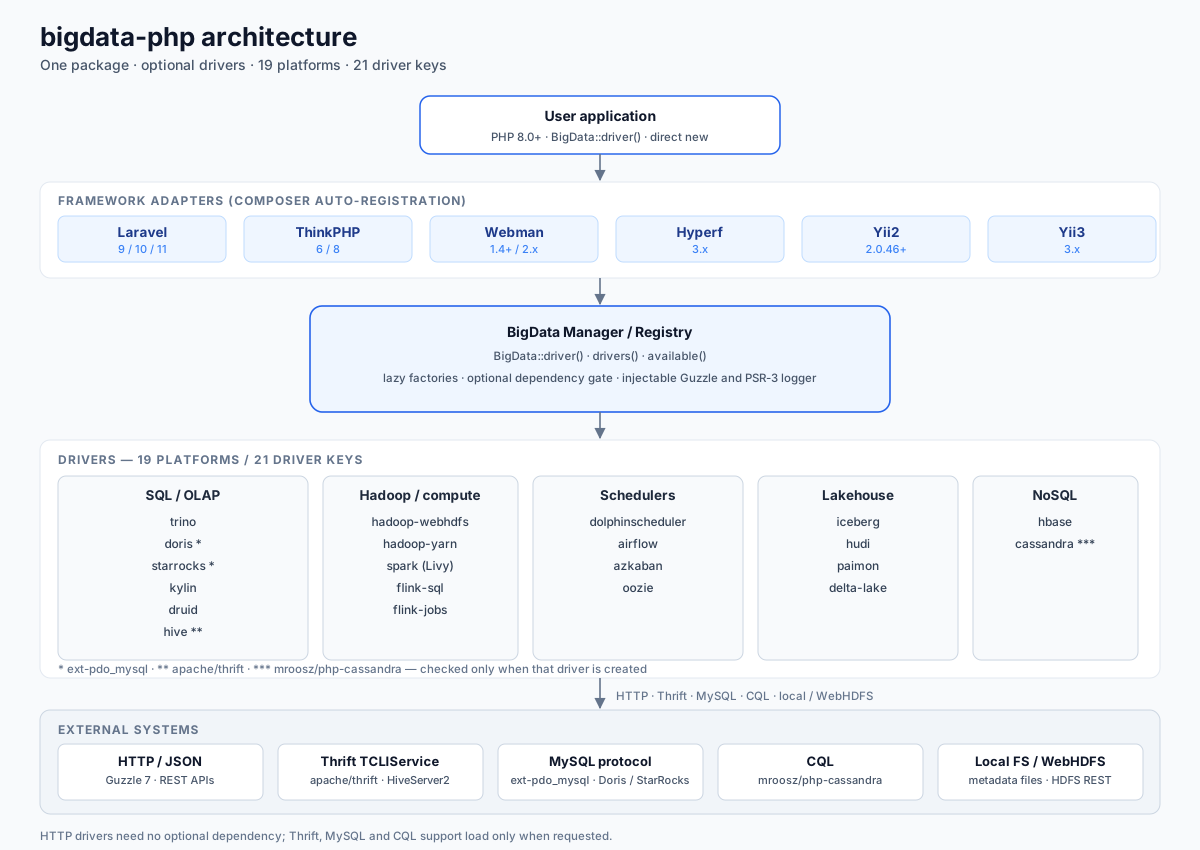
Call path:
- Application layer: business code calls
BigData::driver()directly, or obtainsIntegration\Managerfrom the container through a framework adapter. - Framework adapter layer (optional): the Laravel, ThinkPHP, Webman, Hyperf, Yii2, and Yii3 adapters read the
default/driversconfiguration and bindManagerto the container; they introduce no ORM, query builder, or extra abstraction. - Manager / Registry:
Managerhandles configuration resolution and instance caching;BigDatainternally maintains a static map from the 21 driver keys to factory closures, and both unknown keys and missing optional dependencies are intercepted here. - Driver layer: one directory per platform, containing
XxxConfig,XxxClient(some drivers also have a dedicatedResultSetor exceptions). Shared HTTP, result-set, config, and exception code lives insrc/Support/andsrc/Exception/; a driver depends only on its own configuration and the injected HTTP / log instances. - External systems: HTTP / JSON (Guzzle 7), Thrift TCLIService, MySQL protocol (PDO), CQL, local filesystem, or WebHDFS.
Key constraints: drivers are created on demand and cached by name; Manager never connects to any external system during construction; the HTTP client and logger can be injected from above, making it easy to apply uniform timeout, proxy, and logging settings.
Functional Design
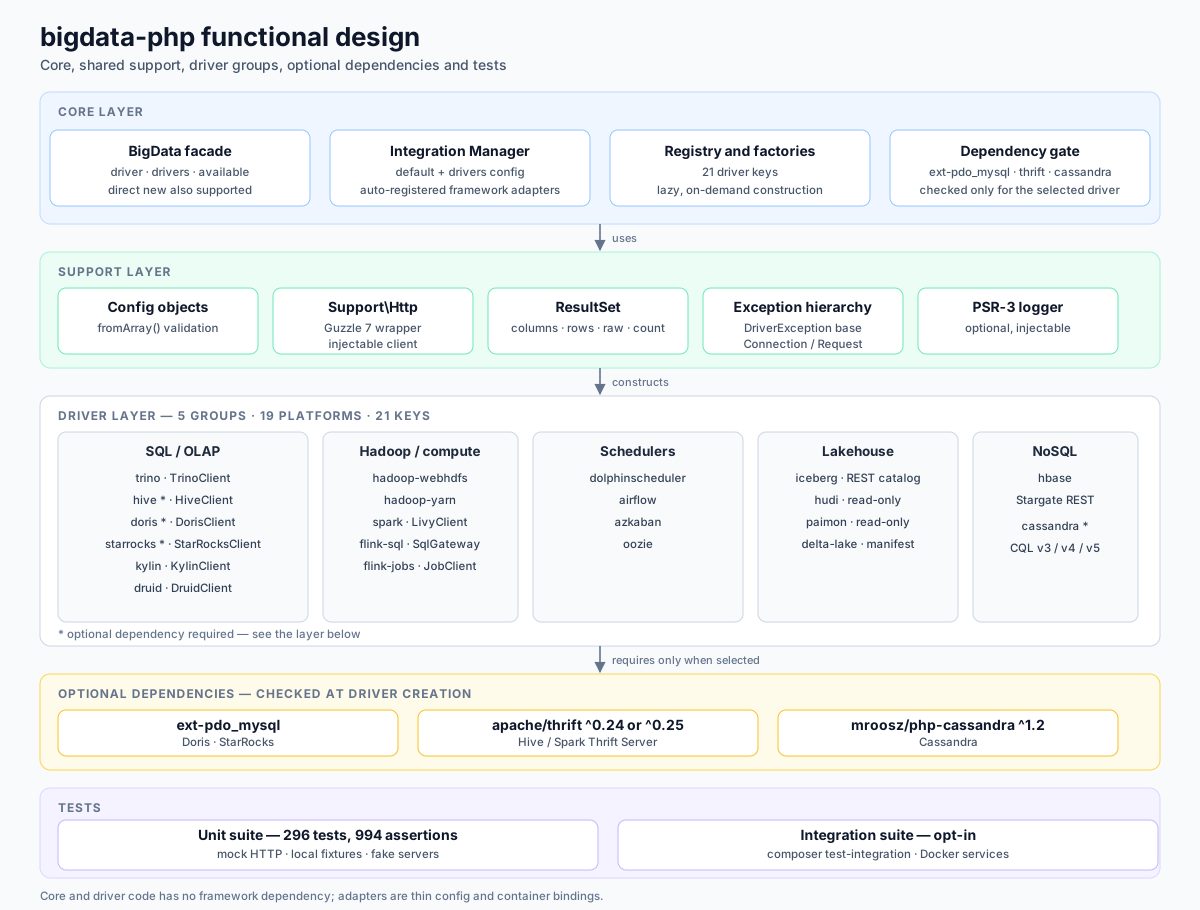
The code is divided into five layers:
- Core: the
BigDatafacade (driver/drivers/available),Integration\Manager, the driver registry, and the optional dependency gate. The core layer only does name resolution, config merging, and factory invocation. - Support: shared
Support\Http(a thin Guzzle 7 wrapper),Support\ResultSet,Support\Config, and an exception hierarchy rooted atBigDataException; connection and request failures land inConnectionExceptionandRequestExceptionrespectively. Hive, Cassandra, Doris, and StarRocks keep dedicated hierarchies, while Hudi/Paimon/Delta Lake metadata errors keepHudiException/PaimonException/DeltaLakeException. - Driver: 19 platform-isolated directories, grouped into five categories: SQL / OLAP, Hadoop / compute, Schedulers, Lakehouse, and NoSQL. Drivers do not share client instances, and there is no cross-driver unified SQL layer.
- Optional dependencies:
ext-pdo_mysql(Doris/StarRocks SQL only),apache/thrift,mroosz/php-cassandra,aws/aws-sdk-php(S3 only). Hive and Cassandra are checked when the driver is created, PDO when SQL is invoked, and S3 when storage is read. - Tests: unit tests use mock HTTP, local fixtures, and a fake server; integration tests form a separate group and connect to real services on demand.
The goal of this structure is "a unified entry point without unified semantics": configuration, result sets, and exception naming stay consistent, but each driver still works according to the target system's protocol and error model.
Request Lifecycle
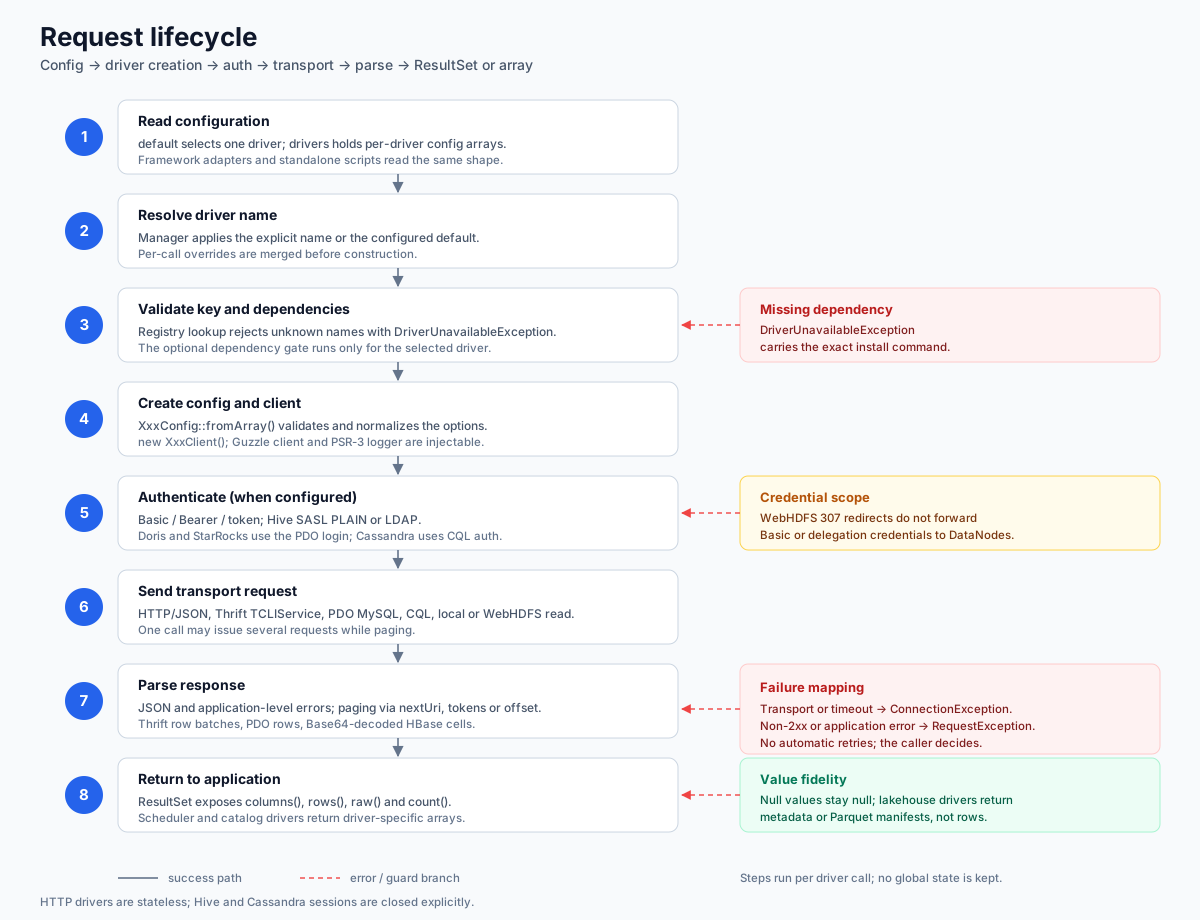
A typical driver call goes through 8 steps:
- Read configuration: the application or framework adapter reads
defaultanddrivers; standalone scripts pass the config array directly toBigData::driver(). - Resolve the driver name:
Manageruses the explicit name or the default name; when callingBigDatadirectly, the caller passes the name. - Validate the driver key and optional dependencies: the registry checks the name;
doris/starrockscheckpdo_mysql,hivechecksapache/thrift, andcassandrachecksmroosz/php-cassandra. - Create config and client: the factory calls
XxxConfig::fromArray(), then constructsXxxClient; the Guzzle client and PSR-3 logger can be injected. - Authenticate (if needed): HTTP Basic / Bearer / token, Hive SASL PLAIN or LDAP, Doris / StarRocks PDO login, Cassandra CQL authentication.
- Send the transport request: HTTP/JSON, Thrift TCLIService, PDO MySQL, CQL, local or WebHDFS reads; paginated requests may issue multiple calls at this step.
- Parse the response: handle JSON and application-level errors under HTTP 200, follow
nextUri, result tokens, or offsets, and parse Thrift row batches, PDO rows, or Base64-encoded HBase cells. - Return the result: query drivers return
ResultSet; scheduler / catalog drivers return driver-specific arrays; Hive and Cassandra sessions are explicitly closed by the caller withclose().
Error mapping: transport failures, timeouts, and connection errors throw ConnectionException; HTTP non-2xx responses or application-level errors throw RequestException. No driver retries automatically; the caller decides whether to retry based on idempotency.
Lifecycle
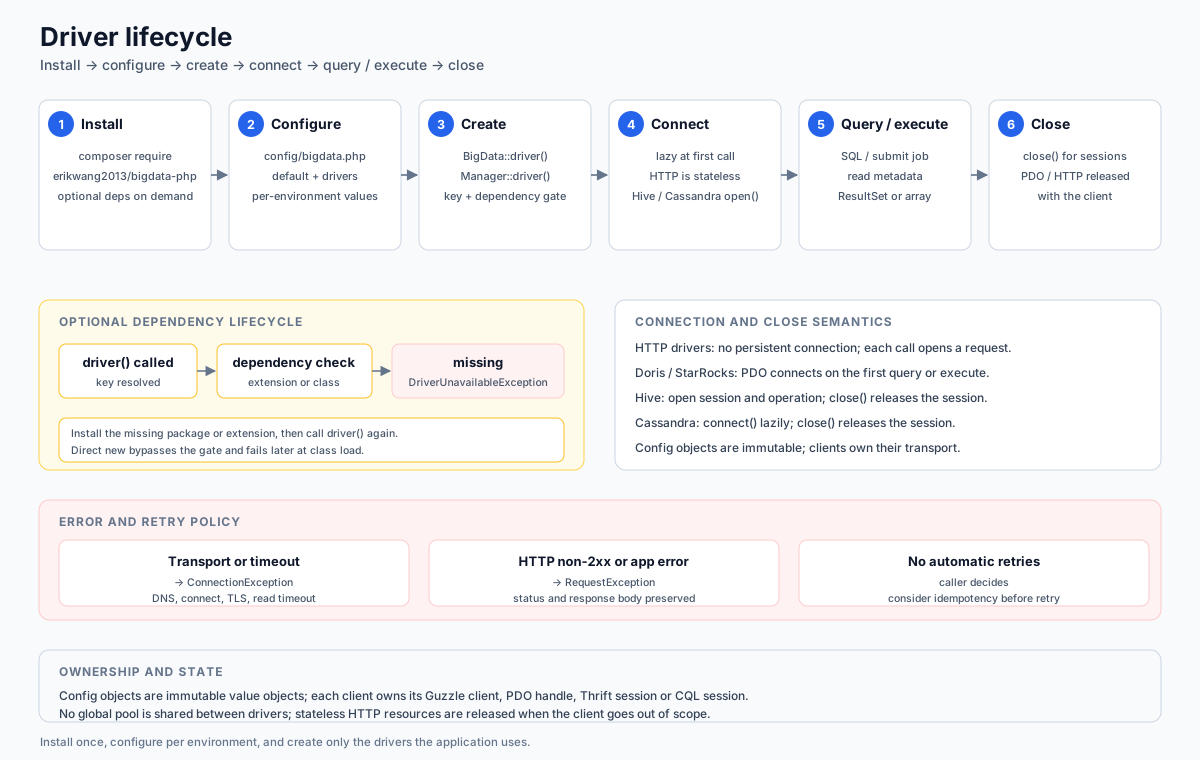
| Stage | What happens |
|---|---|
| Install | composer require erikwang2013/bigdata-php; install apache/thrift, mroosz/php-cassandra, or enable pdo_mysql only when needed. |
| Configure | Prepare the default / drivers array, or publish the framework config file; see each driver's documentation for its fields. |
| Create | BigData::driver($name, $config) or Manager::driver($name); the driver key and optional dependencies are checked at this point. |
| Connect | Most drivers establish a connection only on the first query or execution; HTTP drivers have no persistent connections, while PDO, Hive, and Cassandra open connections on demand. |
| Query / execute | Run SQL, submit jobs, read metadata, or write via Stream Load; results come back as ResultSet or arrays. |
| Close | Hive and Cassandra provide close() to release the session; PDO and HTTP resources are released with the client instance. |
Optional dependencies have an independent lifecycle: Hive/Cassandra check their class when the driver is created, ext-pdo_mysql is checked on the first Doris/StarRocks SQL call, and S3 storage is checked on the first read; a missing dependency raises an exception with an install hint. Directly new-ing a client bypasses the creation-time check.
Directory Structure
bigdata-php/
├── src/
│   ├── BigData.php              # Driver registry, factories, and optional dependency checks
│   ├── Install.php              # Webman plugin installer
│   ├── Driver/
│   │   ├── Trino/
│   │   ├── Hadoop/
│   │   ├── Hive/
│   │   ├── Spark/
│   │   ├── Flink/
│   │   ├── Doris/
│   │   ├── StarRocks/
│   │   ├── Kylin/
│   │   ├── Druid/
│   │   ├── Iceberg/
│   │   ├── Hudi/
│   │   ├── Paimon/
│   │   ├── DeltaLake/
│   │   ├── DolphinScheduler/
│   │   ├── Airflow/
│   │   ├── Azkaban/
│   │   ├── Oozie/
│   │   ├── HBase/
│   │   └── Cassandra/
│   ├── Integration/             # Framework adapters and Manager
│   │   ├── Manager.php
│   │   ├── Laravel/
│   │   ├── ThinkPHP/
│   │   ├── Webman/
│   │   ├── Hyperf/
│   │   ├── Yii2/
│   │   └── Yii3/
│   ├── Support/                 # Shared HTTP, ResultSet, and config helpers
│   └── Exception/
│       ├── BigDataException.php
│       ├── ConnectionException.php
│       ├── RequestException.php
│       └── DriverUnavailableException.php
├── config/                      # Framework config samples
├── docs/
│   ├── diagrams/                # Chinese/English architecture, functional, request lifecycle, and lifecycle SVGs
│   ├── drivers/                 # Detailed docs for the 19 platforms (en/ for English)
│   ├── frameworks/              # Six framework guides (en/ for English)
│   ├── pet.svg / pet-expressions/  # Project pet and 12 animated expressions
│   └── site/                    # Site content source, build and deployment config
├── scripts/                     # Site build / check scripts
├── site/                        # Local site build output (gitignored, not packaged in releases)
├── tests/
│   ├── Driver/                  # Unit tests and fixtures
│   └── Integration/             # Integration tests, run on demand
├── demo/                        # Trino / Flink / Airflow / Cassandra demos
├── composer.json
├── phpstan.neon
├── phpunit.xml / phpunit-8.0.xml
├── ASSETS-LICENSE.md
├── CHANGELOG.md
├── README.md
└── README_EN.md
Tests
composer test              # Unit tests, no real cluster required
composer test-integration  # Integration tests, require available external services
Unit tests use a mock HTTP client, local fixtures, and a fake server, covering 296 tests and 994 assertions, plus 14 integration tests. The test suite is split into the unit and integration groups in phpunit.xml; the default composer test runs only unit and excludes tests/Integration.
Integration tests run on demand—Cassandra, for example, requires a reachable instance; demo/ provides Docker Compose configurations for Trino, Flink, Airflow, and Cassandra as a starting point for local verification.
Limitations
- Lakehouse metadata is read-only: Iceberg reads the REST Catalog and table metadata; Hudi reads the
.hoodietimeline; Paimon reads schema / snapshot; Delta Sharing returns Parquet file manifests. None of them read Parquet row data or perform predicate pushdown or query execution. - Delta Sharing returns no rows:
DeltaSharingClient::query()returns file manifests and metadata; the caller must read the actual data according to the manifest. - Hive authentication scope: supports NONE, NOSASL, SASL PLAIN, and LDAP (QOP
auth); NONE/PLAIN/LDAP use SASL PLAIN and NOSASL disables it; Kerberos / GSSAPI are not supported. Binary transport can use TLS viatls => true; HTTP transport usesscheme => https. - Cassandra is optional and may collide on names: the driver wraps
mroosz/php-cassandra, which shares theCassandra\namespace withext-cassandra; loading both at the same time may conflict. - No automatic retries: connection, HTTP, and application-level errors are thrown directly as
ConnectionException/RequestException; retry policies, backoff, and idempotency decisions are the caller's responsibility. - No unified SQL layer or ORM: drivers only adapt protocols; they do not perform SQL dialect translation, cross-source JOINs, transaction orchestration, connection pooling, or model mapping.
- Optional dependency checks happen only in
BigData::driver(): directly instantiating a client skips the check, and a missing extension or class surfaces as a PHP error at runtime. - Driver capabilities are asymmetric: each platform covers only part of its public API; refer to the docs under
docs/drivers/en/for specific methods, config fields, and limitations.
License
MIT. See LICENSE for details.